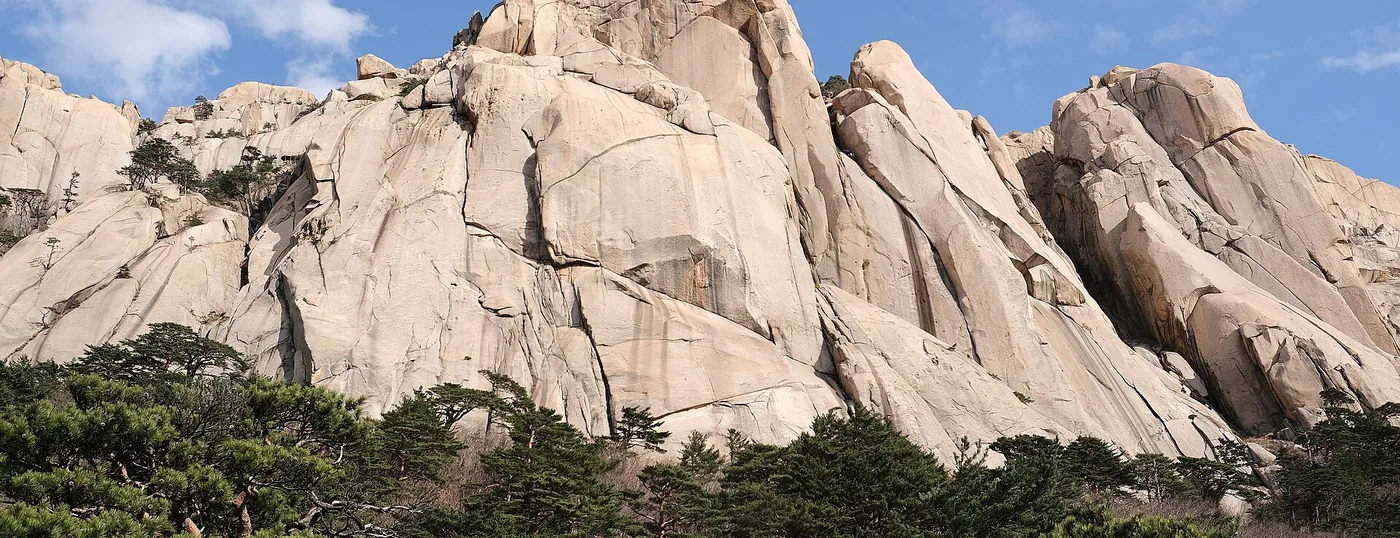
 The Seoraksan massif. Daecheongbong is the high point of the whole range at 1,708 m. ⓒWikimedia Commons · CC BY-SA 4.0The Seoraksan massif. Daecheongbong is the high point of the whole range at 1,708 m. ⓒWikimedia Commons · CC BY-SA 4.0
Seoraksan › Daecheongbong Peak (1,708 m)
Daecheongbong is the summit of Seoraksan at 1,708 m, the third-highest mountain in South Korea, and there are exactly three ways up it. The shortest is 5.0 km from Osaek and takes about 4 hours, which sounds modest until you see that it climbs more than 1,300 m of it on stone steps. No reservation is needed for the summit, but there is a timed entry system, and missing the cut-off is the most common way a trip here fails.
Last checked 2026-09-30 · Korea National Park Service · Korea Forest Service trail geodata · cross-checked against the Korean edition of this page
Seoraksan has 131.1 km of trail, but the summit is served by three approaches. Which one you take decides what kind of day you get, because the mountain is really three landscapes: the deep valleys of Inner Seorak to the west, the granite spires of Outer Seorak to the east, and the Osaek side to the south, which is the short way up and a hot-spring village.
The Sogongwon route breaks into official segments: Sogongwon to Biseondae 3.0 km in 1 hour 20 minutes, Biseondae to Huiundae shelter 5.5 km in 3 hours 10 minutes, Huiundae to Daecheongbong 2.5 km in 2 hours 10 minutes. Continue down to Osaek from the summit and it becomes a 16 km, 10-hour-40-minute traverse in a day.
From the Namseorak trail support centre at Osaek to the summit is 5.0 km and 4 hours, and it is the standard route for a sunrise on Daecheongbong. But the elevation gain is more than 1,300 m over that 5 km, and it is stone steps from bottom to top with very little relief. Judging it by the distance is the classic mistake here. The round trip is 10 km and 8 hours.
The timed entry system is the thing that catches people out. Osaek to Daecheongbong opens at 03:00 and closes at 12:00 from April to October, and 04:00 to 11:00 in winter. Biseondae to Yangpok is 03:00 to 14:00 in summer. Arrive outside the window and you are turned back at the gate, with a booking or without one.
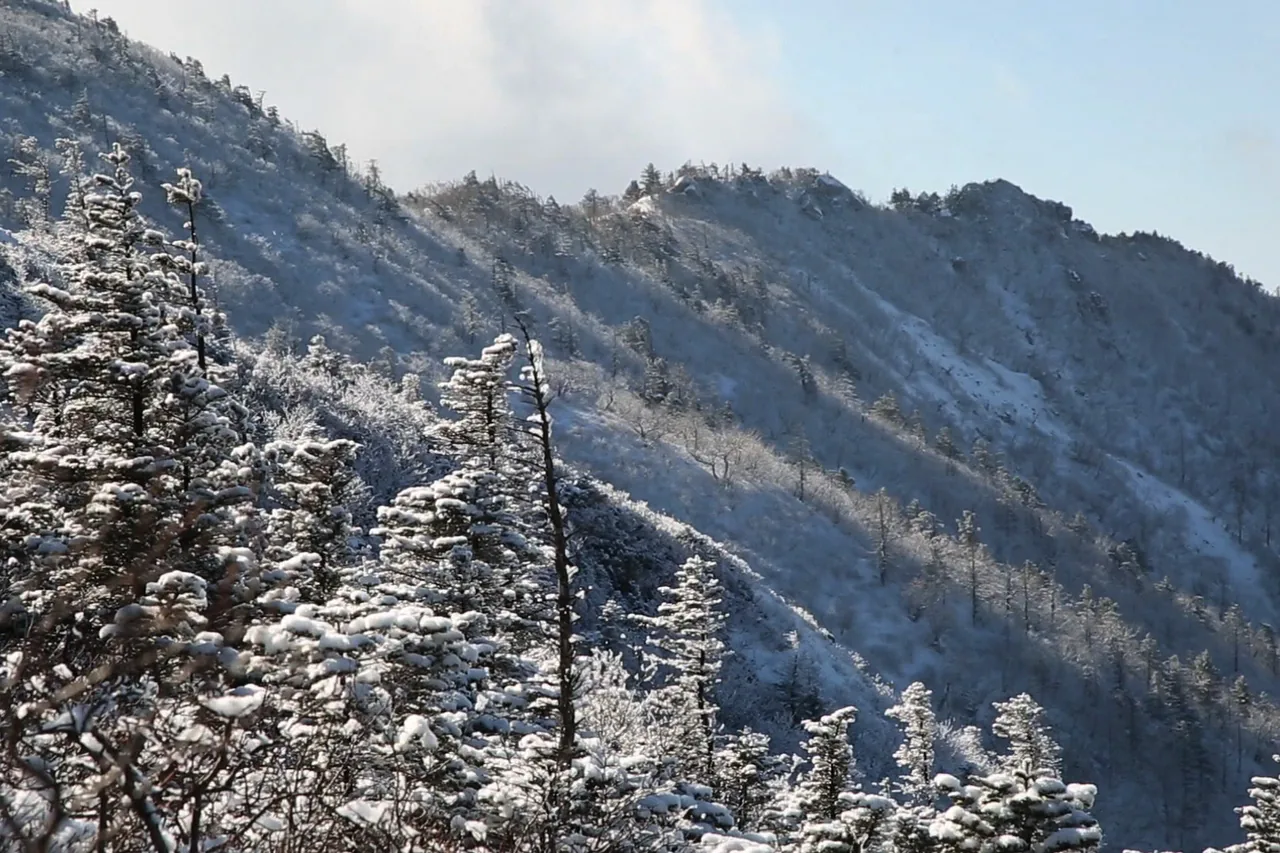
Daecheongbong itself needs no reservation. On Seoraksan the booking system applies only to the Gombaeryeong section, capped at 350 people a day, and to overnight shelters, which go through reservation.knps.or.kr on a first-come basis. What does stop you is the fire season: in 2026 the closures ran 4 March to 15 May and 15 November to 15 December. Those dates move each year, so check them before anything else.
If you want the summit as part of a longer walk, the Gongnyong ridge traverse from Sogongwon over Madeungnyeong to Osaek is 19.1 km and 14 hours 40 minutes, and the Baekdam approach from Baekdamsa by way of Bongjeongam is 12.9 km. Both are done as day trips by some people and as one night in a shelter by most.
This comes up constantly, so to be plain about it: the Seorak cable car goes to Gwongeumseong, at roughly 800 m, and it is not a way to reach Daecheongbong. It is a 1.128 km ride taking 5 minutes, 16,000 won return for adults and 12,000 won for children, sold only on the day at the ticket window, with no one-way fare and no advance booking (☎033-636-4300). Operating hours are set daily according to the weather and posted on the operator's front page.
A second cable car has been under construction on the Osaek side for years. As of 2026 it is not open; the project has been delayed and completion is now expected around the end of 2029. Reaching the summit by cable car is not possible and will not be for some years. Daecheongbong is walked.
The three routes have three different destinations, so set the right one. Osaek is the Namseorak trail support centre; Outer Seorak is Seoraksan Sogongwon; the ridge route is Hangyeryeong rest area. Sokcho is the hub: buses run frequently from Seoul's Dong-Seoul and Express Bus terminals, and local buses 7 and 7-1 run from Sokcho to Seoradong for Sogongwon. For Osaek, intercity buses toward Hangyeryeong stop at the Osaek stop.
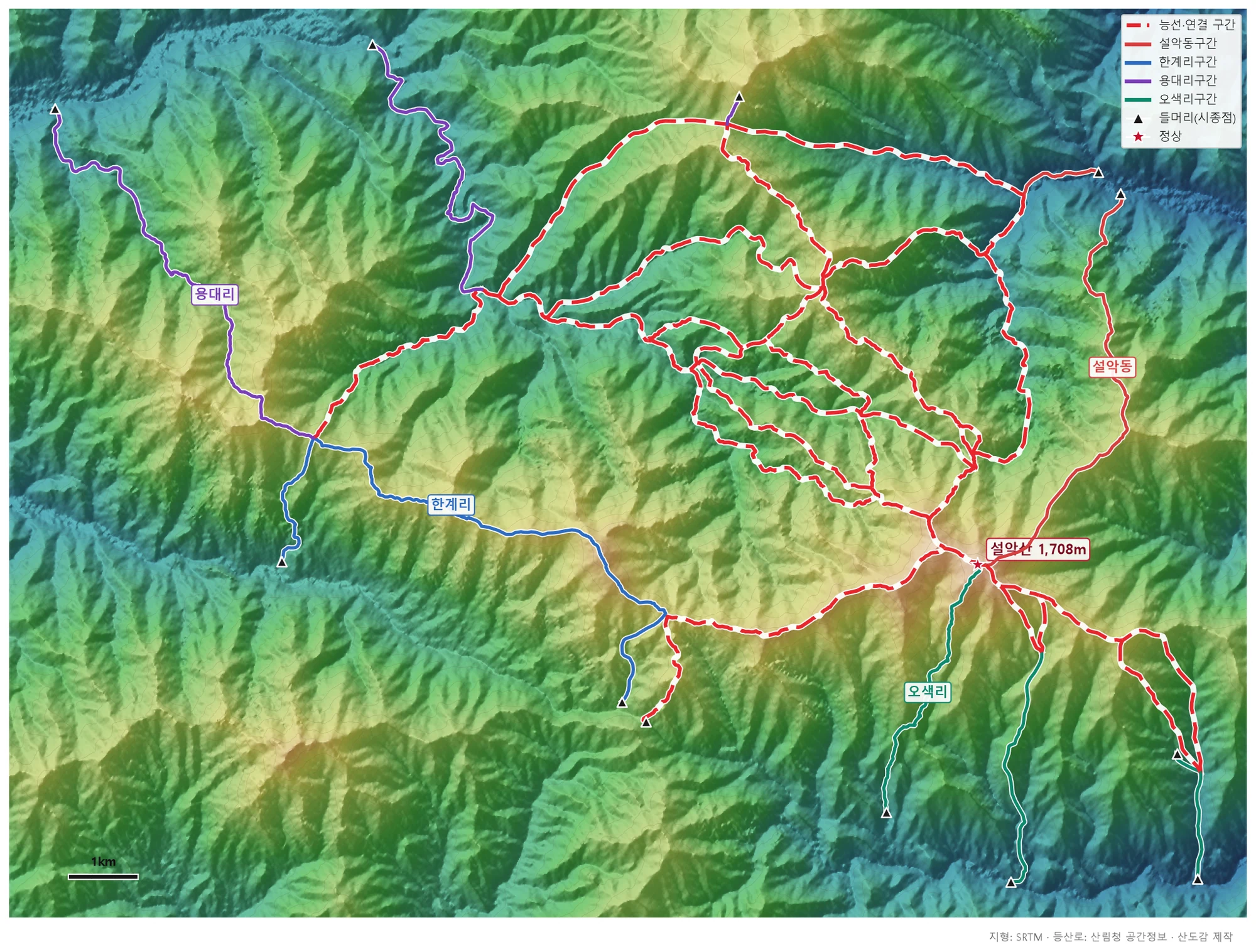
🗺 Open the full-size trail map
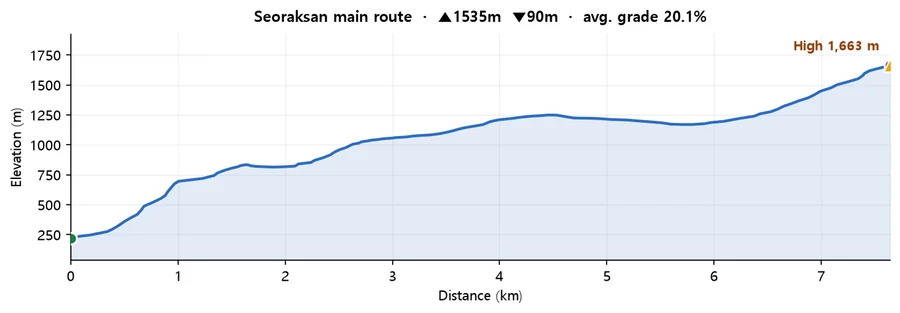
Calculated from SRTM terrain elevation (DEM) over 7.64 km. A moving average and a 4 m threshold are applied to damp GPS noise, so the figures run conservative rather than inflated. This is the mountain-wide profile for Seoraksan drawn from Korea Forest Service trail geodata, not a track recorded on one route to Daecheongbong. Use it for the scale of the climb rather than for turn-by-turn detail. It is built from the path with the most total ascent, so it represents the hard end of what the mountain asks. The trail data can stop short of the summit, so the high point shown may sit below 1,708 m.
Daecheongbong is one summit on a park with 131.1 km of trail, a UNESCO Biosphere Reserve since 1982 and a national park since 1970. For the other routes, the valley walks, the cable car, the seasonal closures and the GPX download, see the Seoraksan guide. The best half-day alternative is Ulsanbawi.
Q. How high is Daecheongbong Peak?
1,708 m. It is the summit of Seoraksan and the third-highest mountain in South Korea, after Hallasan on Jeju and Jirisan.
Q. What is the shortest route up Daecheongbong?
Osaek, on the south side: 5.0 km one way in about 4 hours, or 10 km and 8 hours for the round trip. It is the shortest but not the easiest, because it gains over 1,300 m on stone steps almost without a break. It is also the standard route for a sunrise on the summit, since the entry gate opens at 03:00 in summer.
Q. Do I need a reservation to climb Daecheongbong?
No. On Seoraksan, reservations apply only to the Gombaeryeong section, which is capped at 350 people a day, and to overnight shelters. What does apply to Daecheongbong is the timed entry system, and the fire-season closures, which in 2026 ran 4 March to 15 May and 15 November to 15 December.
Q. What time can I start walking?
From Osaek to Daecheongbong the gate is open 03:00 to 12:00 from April to October and 04:00 to 11:00 in winter. Biseondae to Yangpok is 03:00 to 14:00 in summer. Outside those windows you are turned back, so check the times for your date before you set an alarm.
Q. Can I take the cable car to Daecheongbong?
No. The Seorak cable car goes to Gwongeumseong at about 800 m, which is a viewpoint, not the summit. It costs 16,000 won return for adults, is sold on the day only with no advance booking and no one-way fare, and takes 5 minutes over 1.128 km. A second cable car on the Osaek side is still unbuilt as of 2026, with completion now expected around the end of 2029.
Q. Can Daecheongbong be done in one day?
Yes. The Osaek round trip, 10 km and 8 hours, is the standard day hike, and the early gate opening helps. The full traverse from Sogongwon over the summit to Osaek is 16 km and 10 hours 40 minutes, which is a long but feasible day for strong walkers. The Gongnyong ridge at 19.1 km and 14 hours 40 minutes is usually done with a night in a shelter.